
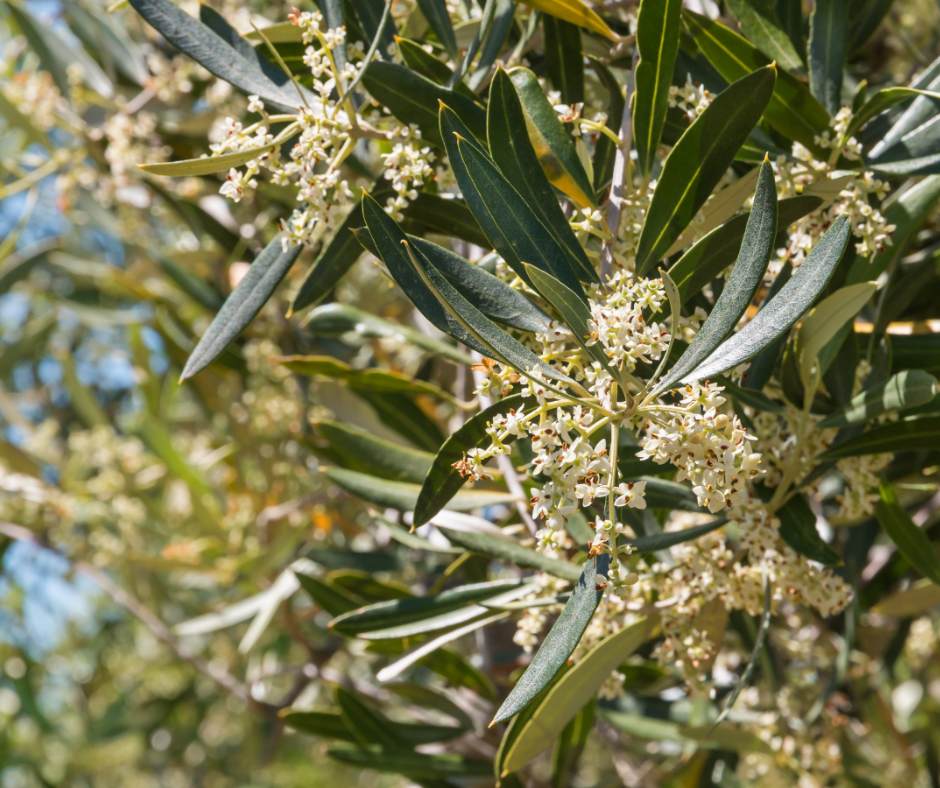
The Olive Tree Bloom: When Everything Begins
There is a moment in the year that those who work in olive groves learn to recognize first with their eyes and then with their sense of smell. It arrives in spring—usually between May and June on the hills around Lake Garda—and it is discreet, almost shy. Nothing as spectacular as the blossoms of a cherry or almond tree. Yet it is the moment when much of that year’s harvest is determined.
It is the olive tree bloom, and it is worth getting to know.
What Olive Blossoms Look Like
Olive trees do not produce large, showy flowers. Their blossoms are small, creamy white, and grouped in clusters called “mignole”, from the Latin *amygdala*, meaning “almond,” due to the pointed shape they take on before opening.
Each cluster can contain between fifteen and thirty flowers, and each tree produces thousands of them.
Most flowers contain both male and female parts, but olive trees are mainly wind-pollinated, and in most of the cases it produces perfect but sterile flowers. Of all the flowers on a tree, only a small percentage will become olives—under ideal conditions, about one flower out of a hundred.
This is not inefficiency; it is simply the nature of the olive tree, which produces in abundance to compensate for very strict natural selection
What Happens During Blooming Around Lake Garda
On the hills of Lake Garda, blooming typically begins in late May and continues through June.
Weather conditions during this period are crucial. Olive trees require
Mild temperatures between 15 and 25° degrees. Cold temperatures stop the development of the clusters. Extreme heat causes them to wither before the flowers fully open. Late freezing- a real risk in spring on garda lake- can destroy entire flower clusters in just a few hours
Gentle and steady winds are essential for transporting pollen from one plant to another. Lake Garda naturally promotes steady air circulation, making this area particularly well-suited for wind pollination
Absence of heavy rain during flowering. The rain beats down on the flowers, scatters the pollen, and in the worst cases causes the flowers to fall prematurely before pollination even takes place
This window is short—often less than two weeks for each variety—and what happens during those days directly affects the autumn harvest.
Differences Between Our Varieties
Casaliva, Leccino, and Gargnà do not bloom at exactly the same time, nor do they respond in the same way to weather conditions. This time lag, which may seem like a problem, is actually one of the most valuable characteristics of a multi-variety olive grove.
Casaliva blooms slightly earlier than the others and benefits from cross-pollination but it produces better results when there are other compatible varieties around.
Leccino is self-sterile and requires pollinating varieties to produce. The best of those is Pendolino, its natural partner in systems.
Gargnà flowers abundantly but is the most sensitive to adverse weather conditions. An irregular spring can affect Gargnà respect to other cultivars, which partly explains his inconsistent productivity.
Growing several varieties together is not only a way to diversify the final product; it is also an agronomic strategy that increases the resilience of the entire grove.
Blooming Is Observed, Not Controlled
One of the lessons olive trees teach growers is patience. You can’t speed up flowering; you can’t schedule it precisely; you can’t correct it if the weather conditions aren’t favorable.
However, it can be observed. One can learn to read the buds—their density, their color, the moment they begin to open—to understand in advance how the season is unfolding. One can influence the plant’s health in the preceding months, through balanced pruning and careful soil management, to ensure flowering occurs under the best possible conditions.
And we can wait. Patiently, carefully, with that respect for the rhythms of nature that underlies all the work we do in the hills around Lake Garda.
Would you like to see olive blossoms up close? Spring visits to the olive groves are particularly fascinating and allow you to discover what is happening plant by plant, flower by flower.