
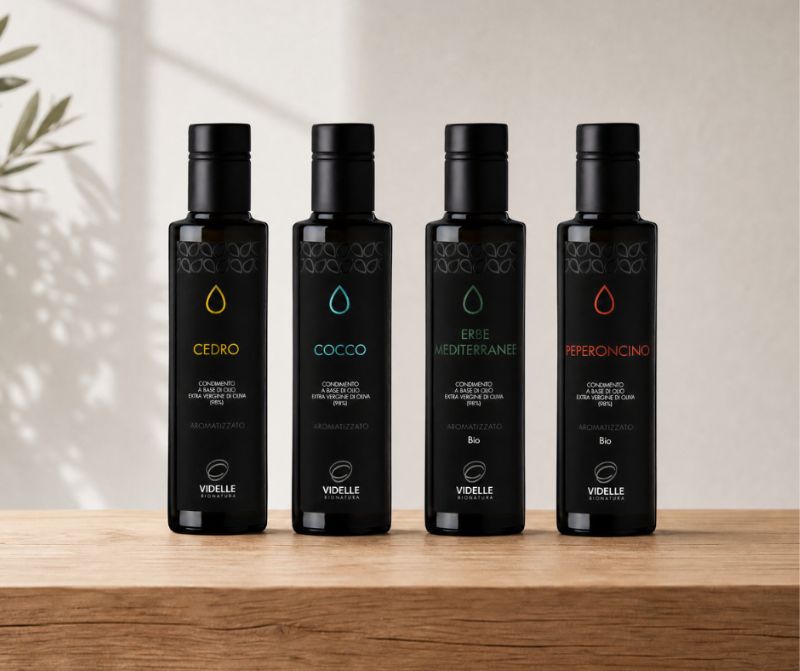
Our flavored oils: how they’re made and what sets them apart
When people find out we make flavored oils, the reaction is often the same: a moment of surprise, sometimes a bit of skepticism. Flavored oil has a tough reputation — supermarket shelves lined with colorful little bottles of artificial flavoring, flat tastes that vaguely resemble something without really being anything.
We understand that wariness. And that’s exactly why we want to tell you how ours are made.
The starting point: an oil worth flavoring
The first question to ask, when it comes to a flavored oil, is simple: what’s the base?
An industrial flavored oil often starts from a mediocre-quality extra virgin, where the added flavoring serves to cover up flaws or to give character to a product that wouldn’t have any on its own. It’s a cover-up, not an enhancement.
Our flavored oils start from Penitenti organic extra virgin olive oil — the same one we produce in our hillside olive groves, with the same care, the same standards, the same attention we bring to our monocultivars. An oil that already has its own identity: green fruity notes, herbaceous hints, balanced bitterness and spice.
Flavoring an oil like this doesn’t mean hiding it. It means pairing it with something that complements it, that opens up new ways to use it, that creates a dressing capable of doing more than one thing at once.
How they’re made: natural infusion, not chemistry
The method used to flavor an oil changes everything.
The most common industrial method uses concentrated natural or artificial flavorings, added directly to the oil in calibrated percentages. The result is uniform, stable, reproducible — but it’s also flat, leaving that unmistakable synthetic aftertaste on the palate.
Our method is different: we work by infusing the flavoring ingredients directly in the oil. Herbs, spices, and fruits are put in contact with the extra virgin oil and left to release their aromatic compounds over time, naturally. It’s a slower process, less predictable in its exact results, but the only one that produces a real flavor — because it is, literally, the flavor of that ingredient, not its chemical simulation.
The result is an oil that tastes of lemon because it contains lemon. That tastes of truffle because it contains truffle. That tastes of chili because the chili was really in there, and left behind everything it had to give.
The ten varieties: a journey through the kitchen
Our flavored range includes ten dressings, designed to cover a wide range of kitchen uses — from classic Italian pairings to more unexpected combinations.
Organic Lemon and Citron
Two citrus fruits from the Garda region, two different characters. Lemon is more direct, more acidic, with that citrusy freshness that works immediately with fish, carpaccio, summer salads, and shellfish. Citron is more delicate, more fragrant, with an aromatic complexity that also lends itself to desserts, fresh cheeses, and more elaborate dishes. Citrus and oil share a common history: it’s not a pairing invented at a desk, but a natural meeting between products of the same land.
Mediterranean Herbs
It’s perhaps the most versatile of the range. A bouquet of aromatic herbs — thyme, rosemary, oregano, sage, bay leaf — that turns any dish into something more complex. It works on grilled meat, roasted vegetables, pizza, bread. It’s an everyday kitchen oil for those who don’t want to compromise on quality even in the simplest preparations.
Black Pepper
Pepper in oil releases different notes compared to pepper ground straight onto the dish: softer, more enveloping, with a spiciness that builds gradually instead of hitting all at once. It’s a dressing for those who love character without aggressiveness. Wonderful on red meat, aged cheeses, eggs, and any winter dish that needs warmth and depth.
Truffle
Truffle is one of those ingredients that divides opinion: you either love it unconditionally, or you find it too much. Our truffle oil is made for those who love it: an intense, enveloping aroma, that earthy, almost animal note that defines the most prized mushroom in Italian cuisine. Just a few drops on a risotto, scrambled eggs, plain pasta, or bruschetta are enough to turn an ordinary dish into something memorable.
Organic Onion
An oil that surprises anyone who hasn’t tried it before. Onion oil doesn’t have the sharpness of raw onion: it has its sweetness, its roundness, that mellow flavor reminiscent of caramelized onion. It’s perfect on legumes, soups, braised meat dishes, and anywhere you want to add depth without acidity.
Garlic
Garlic in oil is a classic of Italian cooking — the soffritto, aglio e olio, the base of a thousand dishes. Having it already prepared in a quality dressing means you can bring that essential flavor even to dishes that don’t require cooking: a bruschetta, a seafood salad, a cold pasta dish. The intensity is there but never overwhelming: you can taste the garlic without being overpowered by it.
Chili and Garlic and Chili
Two variations on the same fiery note. Chili on its own is a direct dressing, for those who want heat without any filters: on pizza, pasta, any dish that needs a kick. Garlic and chili is more complex — the spiciness intertwines with the roundness of the garlic, creating a dressing that does more than one thing at once. It’s the closest thing to a concentrated soffritto, ready to use cold.
Coconut
It’s the most unexpected variety in the range, the one that strays furthest from tradition and calls for the most open mind. Coconut oil brings an exotic sweetness, a rich, fragrant note that works surprisingly well with fish, crudités, Asian-inspired salads, and any fusion dish looking for something different. It’s not for everyone — and that’s fine.
What they all have in common
Different formats, flavors, and characters, but one thing in common: every dressing in our range is organic, starts from the same quality extra virgin olive oil, and is flavored with real ingredients.
Non è un dettaglio di marketing. È la differenza che si sente al primo assaggio — e che si ricorda al secondo.
Want to find out which one is right for you? During our guided tastings, the flavored oils are part of the experience: we explain how they’re made and taste them together, finding the pairings that work best for your style of cooking.