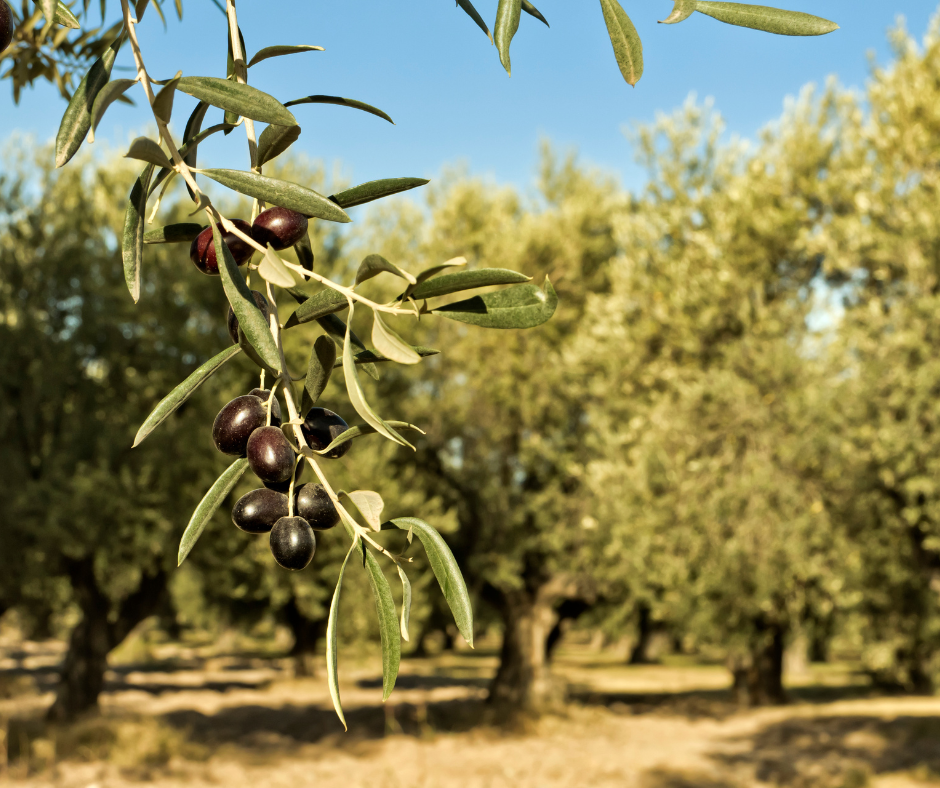
Every day the branches of our olive groves caress the shores of Lake di Garda from which they draw vital nourishment for their sustenance.
And olive cultivation here has its roots in ancient times: suffice it to say that ancient texts tell of groups of Greeks from Athens who settled here, developing agricultural practices and, of course, olive cultivation.
But what makes our territory so unique?
The presence of the great Lake Garda which, thanks to its size, is able to moderate the climate and generate that thermal flywheel that ensures the survival of the olive trees. Let us not forget that we are in one of the northernmost points in the world for its cultivation.
The morainic soils (derived from the retreat of glaciers after the last glaciation) sandy, permeable and excellently exposed, are the perfect ingredient for cultivation.
The soils are rich in minerals, the presence of rock (skeleton in technical jargon), limestone and great permeability give the oils produced from the olives peculiar, fine, balanced flavors and, thanks to the mild but cold climate, unique organoleptic characteristics in the Italian panorama.
Our oils, in fact, are the highest in oleic acid content; the monounsaturated acid par excellence. Polyphenols, vitamin E and antioxidants complete their beneficial characteristics.
But, following the universal law of give and take, as much as the olive trees absorb, the soils must be replenished with the substances absorbed by the plants, leached by the rains and depleted by the climate.
And here our technical ability and our biological philosophy come into play; in an absolutely natural way the soil is enriched again with cattle manure (the best organic substance ever) which, over the years, improves permeability, water retention, and nutrient supply. During the year, instead, on the tree canopies, we use extracts based on marine algae, readily available amino acids and liquid microelements; all this to ensure lush growth and abundant production.
Clearly, the doses, quantities distributed, and distribution times are not random, but arise from specific analyses of the soils that highlight their health status and their strength and ability to offer “nourishment to the olive trees.” Analyses that we carry out every year and correlate with climatic data (rainfall and temperatures primarily); the intertwining of data allows us to establish quantities, doses, types of products, and distribution methods.
I add that everything is designed and reasoned for the respect of the general ecosystem, which is something alive, tangible but extremely fragile and delicate.
In the soil live billions of microorganisms and insects that, although invisible to the naked eye, guarantee and enable the basic organic processes for the life of the flora, fauna, and the soil itself.
It is our duty and responsibility, as a species now recognized as dominant on planet Earth, to maintain all this, for us and for others.
Because the Earth is something incredible, unique, and rare in the universe that surrounds us.