
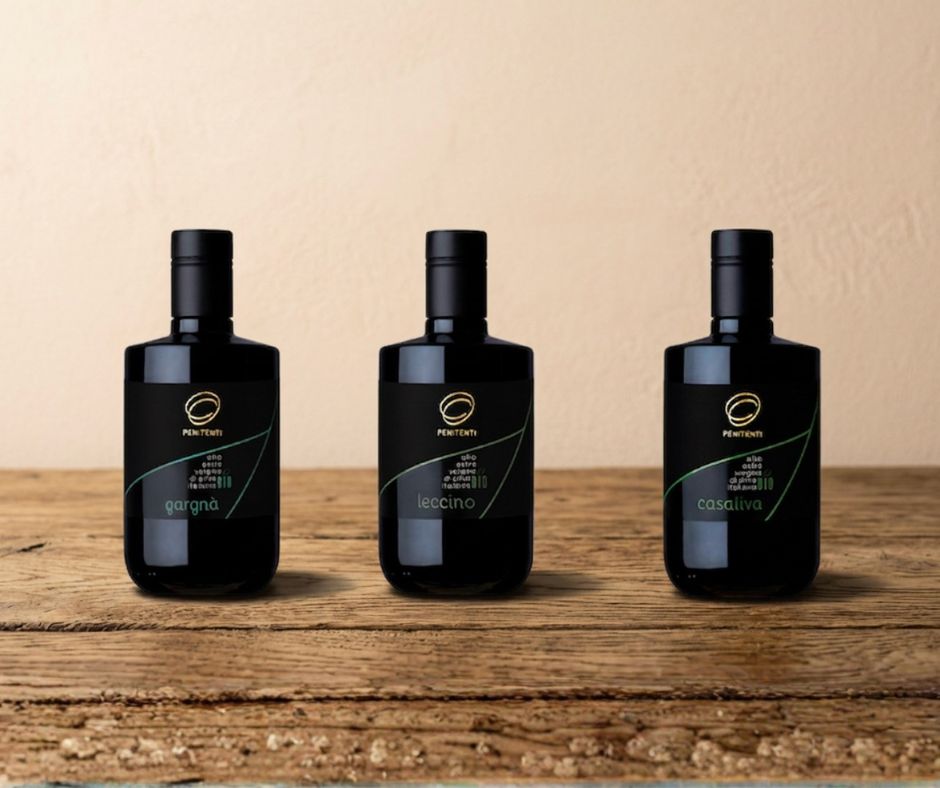
Casaliva, Leccino, Gargnà: three characters, one territory
There are places in the world where the land and climate combine so precisely that they give rise to plant varieties that don’t exist — or don’t express themselves the same way — anywhere else. Casaliva, Leccino, and Gargnà: three different plants, three distinct characters, one shared territory that unites and defines them.
Getting to know them means understanding what’s really inside a bottle of oil — and why not all extra virgin olive oils are the same.
Casaliva: our identity
Casaliva is the flagship cultivar of our territory. Native and historically rooted here, it’s the variety that, more than any other, expresses the olive-growing identity of the Garda area.
Visually, Casaliva has an expansive, elegant canopy, with silvery leaves that catch the light in a distinctive way. Harvesting typically takes place at the start of the season, while the olives are still at the véraison stage — that transitional phase between green and purple — in order to preserve their aromatic potential to the fullest.
In the tasting glass, Casaliva is recognizable for its medium-intensity green fruitiness, with fresh herbaceous notes, hints of artichoke and green almond. The bitterness is present and pleasant, the pungency elegant, never aggressive. It’s an oil with character without being difficult: it’s immediately enjoyable, yet reveals a complexity that emerges with attention.
In the kitchen, it pairs beautifully with lake fish, carpaccio, seasonal salads, and any dish where you want to enhance the main ingredient without masking it. A bruschetta with Casaliva oil is, in itself, a complete experience.
Leccino: balance and versatility
Leccino is one of the most widespread varieties in Italy, but in the Garda context it finds one of its most successful expressions. More rustic than Casaliva, it has historically been valued for its resistance to low temperatures and harsh climatic conditions — a quality that’s far from secondary on our hills, where late frosts remain a constant risk.
It has a generous productive structure, with medium-sized fruits that ripen evenly. Harvesting takes place slightly later than Casaliva, with olives at an advanced véraison stage or fully ripe.
In the tasting glass, Leccino offers a softer, rounder profile. The fruitiness is delicate, with hints of fresh grass, ripe tomato, and light floral notes. Bitterness and pungency are present but measured, and the overall harmony makes it immediately approachable, even for those new to quality olive oil.
That said, it’s not a simple oil: its smoothness is the result of precise ripening and careful processing. It’s proof that balance and complexity aren’t mutually exclusive.
In the kitchen, Leccino is remarkably versatile: it works well with soups, legumes, white meats, fresh cheeses, and as an everyday dressing oil for those who want quality without sacrificing ease of use.
Gargnà: the wild character
Gargnà — a name that directly recalls the territory of Gargnano, on the lake — is the rarest and most distinctive cultivar of the three. Less known to the wider public, it is nonetheless the one that tells the story of the territory in the most authentic and untamed way.
It’s a vigorous variety, with an expansive habit and alternating productivity — a trait common to many native cultivars that follow their own biological rhythms, hard to standardize. It’s precisely this unpredictability that makes it so valuable: Gargnà doesn’t lend itself to mass production, and that’s one of the reasons it remains a rarity even at the local level.
Harvesting is delicate: the olives need to be carefully monitored and picked at just the right moment, since the optimal window is narrower than with the other varieties.
In the tasting glass, Gargnà is a surprise. It has an intense, lively fruitiness, with pronounced herbaceous notes, hints of tomato leaf, aromatic herbs, and a finish marked by bitterness and pungency that are decisive and persistent. It’s an oil with a strong personality, one that doesn’t go unnoticed and that demands — and deserves — attention.
In the kitchen, it shines best with hearty dishes: ribollita, grilled meat, aged cheeses, garlic bruschetta. It’s not a background oil: it’s a lead player.
Monocultivar and cuvée: two philosophies, one single goal
Working with monocultivars means making a precise choice: letting each variety speak for itself, without mediation. It’s an act of transparency toward the taster — and of respect toward the plant and the territory.
But the olive-growing tradition of our territory also knows another form of expression: the cuvée, meaning the carefully considered blending of several cultivars. This isn’t a lack of identity, but a different kind of pursuit: that of balance between complementary traits, of the complexity that comes from their meeting.
When Casaliva, Leccino, and Gargnà are blended with care, they complement and enhance one another: the structure of Casaliva, the softness of Leccino, and the power of Gargnà come together into something none of the three could offer on its own.
Getting to know the individual varieties, then, isn’t only useful for appreciating monocultivars. It also helps you understand what’s inside a cuvée — and why certain bottles manage to tell more than one story at once.
Tasting them to truly understand them
Reading about Casaliva, Leccino, and Gargnà is useful. Tasting them side by side is something else entirely.
Only by lining up three tasting glasses can you truly grasp what “character” means in an extra virgin olive oil: how the color changes, how the aroma shifts even before tasting, how the fruitiness transforms into warmth and lingering intensity. It’s a sensory education that no text can replace.
Curious to discover the differences firsthand? Our guided tastings are designed exactly for this: three oils, three stories, one territory to discover, sip after sip.